
Ontario Already Built a School for the Future. Then We Forgot About It.
What Thornlea Secondary School’s forgotten experiment can teach us about education in the age of artificial intelligence
I recently discovered that the high school I attended for Grade 9 was not originally designed to be an ordinary high school.
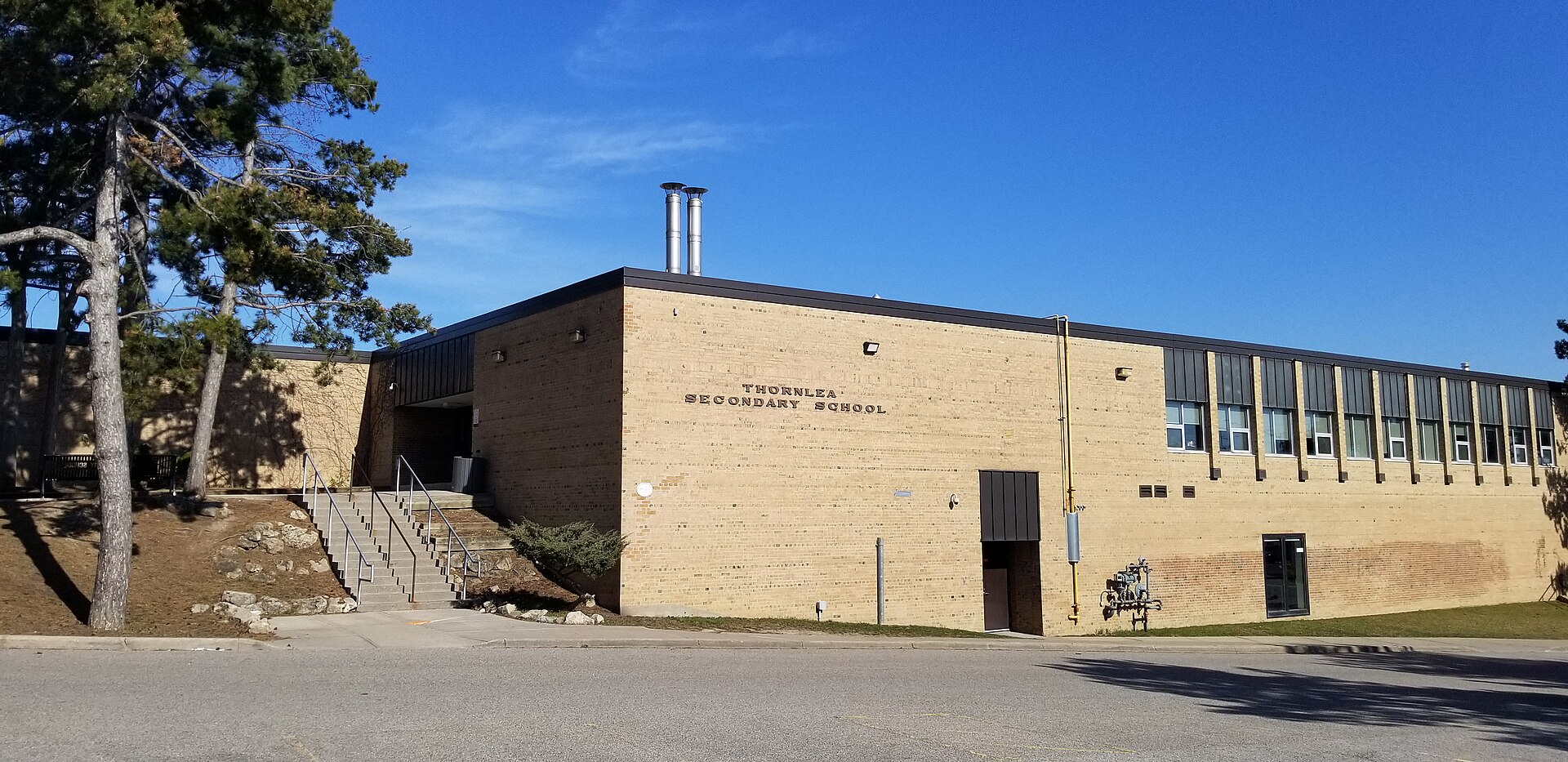
Thornlea Secondary School in Thornhill, Ontario, opened in 1968 as a deliberate experiment in educational innovation. Long before today’s debates about artificial intelligence, personalized learning, student agency and the future of work, a group of Ontario educators was already asking a more fundamental question:
What should a school become when the world it is preparing students for is changing?
I find that extraordinary, partly because I attended Thornlea without knowing any of this.

To me, it was simply the school where I studied computer science using LOGO Turtle and DOS, joined the orchestra, took creative writing, journalism, photography and drama, swam competitively, studied Shakespeare and experienced meditation and visualization in physical education. Only decades later did I discover that I had briefly entered a school built from a very particular philosophy of learning.
Now I cannot help wondering whether Thornlea helped make me who I am.
Not in the simplistic sense that one year at one school determined the direction of my life. Human beings are shaped by thousands of influences. But environments do not merely give us information. They give us permission. They show us which kinds of curiosity are welcome, which connections are possible and whether learning is something we receive or something we actively pursue.
I became a writer, traveller and philosopher whose work moves between technology, psychology, sociology, anthropology, creativity, culture and human intelligence. I have never naturally understood why knowledge should remain divided into neat categories when life itself does not arrive in subjects.
Perhaps Thornlea did not create that way of thinking in me.
Perhaps it recognized it.
Perhaps it encouraged it.
And perhaps that is precisely what education should do.
Ontario’s educational experiment
The origins of Thornlea were remarkably ambitious. In 1966, a forward-looking education director proposed creating a “resource-centred” school with a flexible organization capable of serving multiple educational purposes. Teachers from different subject areas were invited to examine the idea and develop proposals for the new school. They were chosen primarily because they had expressed an interest in educational innovation.
Those teachers formed the Thornlea Study Committee, chaired by educator Stephen Bacsalmasi. Its mandate was not simply to choose textbooks or arrange classrooms. The committee was directed to investigate existing and proposed educational innovations in Canada, the United States and Europe, then make recommendations about the organization and curriculum of the new Thornlea Secondary School.
During the summer of 1967, committee members participated in seminars, small-group discussions and workshops supported by staff from the Ontario Institute for Studies in Education, or OISE. They were given current research publications and curricular material and worked in intensive day-long sessions for six weeks. Their completed report was widely distributed for discussion throughout York County before the school board accepted it without alteration. Art Murch was appointed as Thornlea’s first principal in December 1967 and spent the following months preparing for the school’s opening.
This was not a minor pilot program operating quietly inside a conventional school.
Ontario was creating an entire public secondary school around a different understanding of education.
And the experiment attracted attention well beyond York County.
In 1973, the Organisation for Economic Co-operation and Development included Thornlea in an international volume examining deliberate educational innovation at five secondary schools: Countesthorpe College in the United Kingdom, Oslo’s Experimental Gymnasium, Thornlea in Canada, Rødovre School in Denmark and Tapiola School in Finland. The Thornlea study was written by OISE researchers Michael Fullan, Glenn Eastabrooke, Dan Spinner and Jan Loubser.
That is the international recognition the story deserves: not vague claims that Thornlea was “world famous,” but the far more interesting fact that an Ontario public school was selected for comparative study alongside experimental schools in Europe by the OECD’s Centre for Educational Research and Innovation.
OISE also published a dedicated 46-page case study in 1972, based largely on recorded interviews with teachers, students, administrators, parents and members of the community. The researchers examined not only the frequency of innovation but its quality, implementation, social relationships and consequences.
Michael Fullan would later become internationally influential for his work on educational change. Yet early in his research career, he was studying Thornlea, not merely as a curious school, but as a living example of what happens when a public education system attempts meaningful change.
What Thornlea was trying to create
The committee’s stated objectives sound astonishingly current.
Students were to learn, prepare for and live with change, understand cultural and moral heritage, and develop as human beings. The school’s staff later identified further aims: developing students’ talents, increasing awareness of themselves and sensitivity toward others, sharing responsibility for learning, thinking critically, judging soundly and acquiring the skills needed for self-directed education.
Those objectives matter because they reveal that Thornlea was not designed primarily around content delivery.
It was designed around human development.
The central question was not only, “What should students know?”
It was also, “What kind of people should they become?”
The school used a trimester system rather than relying exclusively on year-long courses. Subjects could be offered at different phases based on difficulty and student responsibility, while the shorter terms allowed students to adjust levels more flexibly. Thornlea developed independent-learning courses in social sciences, English, music and the physical and natural sciences. Students could help define their own programs in consultation with teachers. Individual-progress courses allowed students to follow structured sequences at their own pace.
Teachers sometimes collaborated across departments. A beginner geology course, for example, was jointly taught by science and geography staff. Senior students in music, theatre arts and social sciences were sometimes encouraged to assume teaching responsibilities for younger students.
The trimester system also made it easier to test new courses, independent studies and longer teaching periods that would have been difficult to introduce within a conventional timetable. One such course, The Community and I, grew from discussions about the inadequacy of the standard 40-minute period and the need to use resources outside the school more meaningfully.
Students participated in school governance through advisory bodies, a student council, house representation and policy committees. Thornlea’s leadership structure was less centralized than that of a conventional high school. Alongside the principal were directors responsible for instruction, student services and administration. Researchers described the school as having a relatively diffuse, non-hierarchical operating structure.
Most importantly, principal Art Murch did not see his role merely as controlling the institution. He described himself as a facilitator. He deliberately hired teachers with educational philosophies ranging from radical to conservative, gave them room to propose ideas and protected the school from some external criticism and pressure. Researchers concluded that this helped create an environment in which teachers could initiate new methods and programs on a substantial scale.
This did not mean the experiment was easy or universally successful.
That may be its most valuable lesson.
Freedom alone was not the answer
The OISE researchers did not write propaganda for Thornlea. They documented its tensions.
Teachers, students and parents generally agreed that self-directed learning, critical thinking and personal development were worthwhile goals. But they disagreed considerably about how those goals should be achieved. Some feared that permissive conditions could weaken academic knowledge and basic skills. Others believed conventional academic teaching neglected the social and emotional development of the whole student. Some students flourished with independence; others needed more direction and structure.
That debate has never disappeared.
How much freedom is developmentally appropriate?
Which students thrive with autonomy?
When does guidance become control?
When does independence become abandonment?
How do we honour different abilities, interests and levels of maturity without lowering expectations?
Thornlea did not solve these questions permanently. But it brought them into the open.
Its difficulties also reveal why educational innovation so often fades. A visionary policy is not enough. New structures depend on the people who interpret them, the leadership that protects them, the culture that sustains them and the ability to evaluate what is working without destroying what is emerging.
The researchers found that Thornlea’s innovation came from an unusual combination of conditions: a forward-looking director of education, direct support from the board, a receptive community, a teacher-led planning process, a trusted principal and staff members who were given room to experiment. They called the creation of an entirely new school through such a deliberate search for better methods “surely unique in Ontario.”
But they also identified fragility. The principal acted as a buffer between the school and outside pressure. Some teachers worried that too much depended on individual personalities rather than stable systems. A decentralized culture gave initiative to outspoken innovators, but quieter teachers could struggle to influence decisions. Freedom produced creativity, but it did not automatically produce coherence.
That is not an argument against experimentation.
It is an argument for learning how to sustain it.
Did the philosophy really disappear?
Accounts of Thornlea commonly describe the experimental model as giving way to a more traditional academic environment around 1980. That may be true at the level of formal structure. But board policy and educational culture are not identical things.
A school is more than its organizational chart.
It is teachers who remain after administrators leave. It is department cultures, stories, rituals, habits, expectations and permissions passed quietly from one generation to another. A board can end a trimester system. It cannot instantly erase a philosophy that has entered the bloodstream of a school.
When I attended Thornlea years after its original opening, I encountered computer programming, journalism, photography, creative writing, drama, orchestra, swimming, meditation and visualization. These were not all inventions unique to Thornlea, nor can I prove that every one of them was a direct survival of the 1967 experiment.
But together they created an environment in which technology, art, physical development, communication and imagination could coexist.
That matters.
The school also produced or educated people who went on to make significant contributions in very different fields. Publicly documented alumni lists associate Thornlea with children’s author Gordon Korman, actor Sheila McCarthy, singer-songwriter Hayden, entrepreneur Mark Scheinberg, broadcaster Bill Welychka and musicians connected with groups including Moxy Früvous, The Philosopher Kings and Prozzäk. (Wikipedia)
Korman’s story is especially fitting. His writing career began as a school assignment after a Grade 7 teacher gave students extraordinary creative freedom. He completed his first novel at twelve and was published while still a teenager. (gordonkorman.com)
I would not claim that Thornlea caused the achievements of its graduates. That would be impossible to establish.
But I do think the range is philosophically interesting.
Writers. Actors. Musicians. Academics. Technologists. Entrepreneurs.
Perhaps a school designed to value different kinds of talent should not be judged only by conventional academic outcomes. Perhaps its legacy is also visible in the variety of lives its students imagined themselves capable of living.
AI is not the problem education needs to fight
Today, Ontario faces another educational transition.
Artificial intelligence can retrieve information, produce competent prose, generate images, explain concepts, translate languages, assist with programming and imitate many of the outputs schools have traditionally used to demonstrate learning.
The instinctive response is often defensive.
Ban the tools.
Return to handwritten work.
Police every assignment.
Design increasingly artificial conditions under which students must prove that no machine assisted them.
Some safeguards are necessary. Students still need foundational knowledge, intellectual independence and the ability to recognize when an answer is shallow, biased or wrong. But treating AI only as a threat risks preparing students for a world that no longer exists.
The calculator did not eliminate mathematics.
The internet did not eliminate knowledge.
Photography did not eliminate art.
New tools change which human abilities become most valuable.
When machines can produce answers, students need to become better at evaluating them.
When information is abundant, discernment matters more.
When AI can imitate formulaic writing, original thought becomes more valuable, not less.
When routine intellectual work can be automated, curiosity, synthesis, ethical judgment, communication, imagination and the ability to frame meaningful questions become central.
The danger is not that students will use AI.
The danger is that they will use it without understanding, submit its output without judgment and gradually surrender the very capacities education should be developing.
We should not prepare young people to compete with machines at being machines.
We should help them become more fully human.
What Ontario should do now
Ontario does not need one single model imposed on every school. Thornlea itself demonstrates why that would be a mistake. Students differ. Communities differ. Teachers differ. Innovation imposed rigidly from above soon becomes another form of standardization.
Instead, Ontario should create a new network of public experimental schools and programs, each designed around clearly defined questions and independently evaluated over time.
One might explore human-AI collaboration.
Another could focus on interdisciplinary projects connecting technology, philosophy, science, history, arts and social responsibility.
Others might test more flexible timetables, mixed-age learning, community-based education, apprenticeships, student-designed research, alternative assessment or models better suited to neurodivergent and gifted learners.
Students should learn how generative AI works, where its information comes from, how bias enters systems, how confident errors are produced, how privacy is affected, who owns generated work and when reliance on automation weakens human skill.
But AI literacy should not become another isolated subject.
It belongs inside English, history, science, art, business, civics, philosophy and technology because its effects will reach every part of human life.
Teachers must be central to this work. Thornlea’s original committee was made up of teachers because educators closest to students possess knowledge that cannot be replaced by distant policy design. But teachers also need time, training, professional freedom and access to researchers who can help examine results honestly.
Students must also participate in designing the systems that shape them. Thornlea understood that shared responsibility could itself be educational. Young people should not merely be the objects of school reform. They should learn how institutions work by helping improve them.
Assessment must also evolve. A system obsessed with producing identical, easily measurable outputs will increasingly reward the very work machines perform best. Students should still master essential knowledge, but they should also defend ideas orally, revise work transparently, solve unfamiliar problems, collaborate across disciplines, critique AI-generated material and demonstrate how their thinking changed.
The future does not require less rigour.
It requires a more intelligent definition of rigour.
What did we forget?
The original Thornlea philosophy declared that the true success of the school would eventually be visible in the young Canadians who graduated from it.
That may be the most profound educational measure of all.
Not merely what students remembered on an exam.
Not how efficiently they moved through a timetable.
Not whether they complied.
But what kind of people they became.
Could they continue learning?
Could they live with change?
Could they think critically and judge soundly?
Could they recognize their own abilities while remaining sensitive to others?
Could they contribute something original to the world?
Those were Thornlea’s questions nearly sixty years ago.
They are even more urgent now.
I attended Thornlea for only one year, but I think it may have played a greater role in shaping me than I ever understood. Perhaps it reinforced my refusal to divide creativity from technology, philosophy from ordinary life or human development from education.
Perhaps it helped teach me that knowledge is not a collection of isolated rooms.
It is a living system of relationships.
Ontario once had the courage to build a school around questions like these. It invited teachers to examine ideas from other countries, worked with educational researchers, redesigned authority, tested new structures and accepted that meaningful innovation would involve uncertainty.
We should not romanticize the experiment. Thornlea had contradictions, uneven results and serious implementation challenges.
But we should study it.
Because the lesson of Thornlea is not that one experimental school discovered the perfect educational system.
The lesson is that Ontario once understood education itself must remain capable of learning.
As artificial intelligence changes how human beings work, create and think, our schools cannot become fortresses defending the methods of the past.
They must become laboratories for the future.
We do not help students by shielding them from the digital age.
We help them by giving them the knowledge, judgment, confidence, creativity and humanity required to shape it.
Perhaps Ontario does not need to invent the courage to do that.
Perhaps it only needs to remember that it once had it.
References
Original Thornlea Study Committee Report (1967)
OISE Case Study: Thornlea: A Case Study of an Innovative Secondary School (1972)
OECD – Educational Innovation in Five Countries
York Region District School Board Archives
Michael Fullan publications

