
Tagged: Cognitive Language
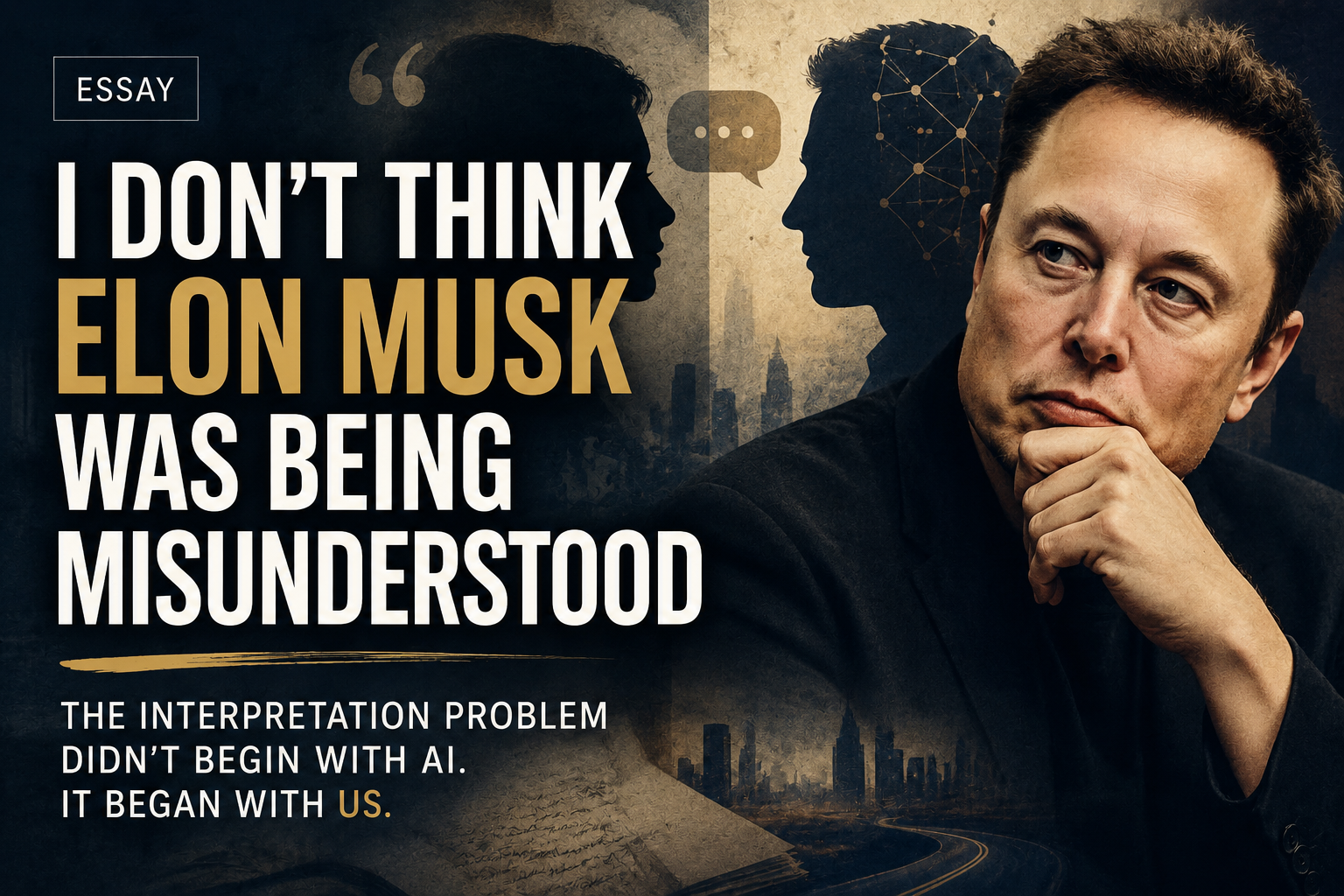
I Don’t Think Elon Musk Was Being Misunderstood. I Think He Was Speaking A Different Cognitive Language.
The interpretation problem didn’t begin with AI. It began with us.
I watched the interview between Elon Musk and Zanny Minton Beddoes, Editor-in-Chief of The Economist, and what fascinated me most wasn’t the politics. It was the mechanics of the conversation itself.
As I watched, I found myself thinking less about whether I agreed with either side and more about why two highly intelligent people seemed to be operating in completely different linguistic universes.
Then I realized… I’ve been studying a variation of this exact dynamic in my own life for years.
Two Lenses, One Mountain
My fiancé, Leon, and I debate ideas constantly. Part of this is purely cognitive, but part of it is cultural: I’m Canadian, and he’s British.
Leon naturally zooms in with sharp, classic British precision, listening for exact wording, specific facts, precise numbers, and internal inconsistencies. If a date is slightly off, if a statistic is rounded, or if a claim isn’t technically accurate down to the decimal, that’s where his attention naturally goes first.
I naturally zoom out. I’m looking for the architecture, the thread connecting one idea to another, the pattern emerging underneath the individual facts.
Neither approach is inherently flawed, and Leon’s sharp eye for detail has saved us both more than once. But when those two cognitive and cultural styles clash without a shared translation layer, they produce friction.
Leon sometimes thinks that if he provides enough granular facts, the picture will shift. I sometimes think that if I can just sketch the overarching model more clearly, the details will fall into place. We’re both trying to build understanding, we’re just climbing the same mountain from opposite sides.
 writingsofamrs.com